
Haven’t you discovered the charm of vinyl flooring yet? After going through this article, you will appreciate it even more, especially if you are thinking about updating your bathroom but feel overwhelmed by the effort it might take.
You can give your bathroom a fresh look in just over a day without making a mess, leading to a hassle-free update. Get ready to remove those outdated tiles that dull the space. New flooring means a new bathroom.
And all this without spending too much money. Vinyl flooring, a durable type of plastic flooring, is ideal for decorating while saving money. The durability of the floor and walls plays a big role in the final appearance of the bathroom. With this update and some new accessories and towels, you’ll achieve what you want: a stylish and modern bathroom!
Things to consider when installing vinyl flooring
Whatever your idea, there is vinyl flooring for your bathroom. There are both templates and images. Colors, textures and finishes that imitate wood, marble, stone, ceramic, cement, concrete and even plumbing fashion. Printing the final layer of vinyl flooring allows you to enjoy the desired finish almost without paying attention to the fact that it is a print.
 Caramel, cinnamon and olive green: the colors of the cold season
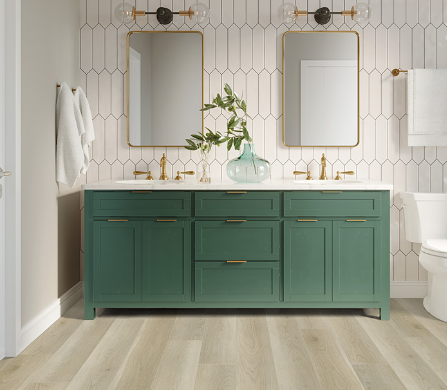
Furthermore, they have improved the quality of this type of flooring so much (they have nothing to do with the first plastic models that appeared, known as sintasol flooring) that they even incorporate its structure, so that the final finish is hard and imitates it exactly. foot touch.barefoot from stone to wood.
Furthermore, to make the sensation underfoot more pleasant, many vinyl flooring models incorporate an additional layer of cushioning during installation. To change the floor without work! And then only some minimal aspects of the bathroom furnishings will need to be taken into account so that the renovation can be completed.
The advantages and benefits of vinyl flooring
 DIY peg boards to keep things organized
The main advantage is that it allows you to change floors without any work. The ease of installation (it rests on the floor you have) and the cut make it perfect for the bathroom, because it is very easy to cut the slats, tiles or tiles to adapt them to the shape of the sink, toilet or bidet, so it is not necessary to remove the toilet to install it.
If you are a handyman you will have no problem doing it yourself and, if not, any parquet designer will install it for you without any problem.
It is also hygienic, safe and easy to maintain. Vinyl floors resist moisture, which is why they are perfect for bathrooms. They can be cleaned with a wrung out cloth and are non-slip.
Due to their composition they prevent the growth of fungi and bacteria, are anti-mite and do not produce static electricity.
 15 small but fantastic pools!
Types of vinyl flooring installation
Tiles, squares, strips or in rolls. All are laid directly on the screed or on the old floor. The most important thing is that the surface on which the vinyl is installed is clean, dry and well leveled.
Tiles and planks come in square and rectangular shapes, while planks are narrow strips of flooring installed in parallel, bone or staggered joints. The roll is continuous vinyl cut to the required size. The tiles, tiles and planks are also cut, usually with a cutter, to adapt them to the dimensions of the room and the shape of the toilet in the case of the bathroom.
There are adhesive vinyl floors and a click system. The former have a built-in adhesive tape, the protective adhesive layer is removed and fixed. An accelerating primer, available from DIY surfacing retailers, can be added to the floor before installing the vinyl to give it more consistency.
The latter are installed by fitting the parts together in a system of male/female slots fixed together. Simple! If you opt for a roll of vinyl, the installation is done with a specific adhesive or double-sided tape.
Durability and resistance of vinyl floors
Most commonly, vinyl flooring is made up of layers. The bottom or support layer is a layer of vinyl, fiberglass or felt, followed by the following layers: the sheathing (usually PVC), the decorative layer that finishes the floor, and a final protective layer of clear vinyl.
This last upper layer of the vinyl floor is what determines its durability and resistance to trampling and rubbing as well as to UV rays. Keep this in mind if your bathroom floor receives direct natural light. Choose its resistance depending on the use you will make of the bath, from moderate (with a top layer of 0.07 to 0.2 mm) to intense or very intense (from 0.2 to 0.5 mm).
It is also important to take into account the total thickness of the slats and tiles, because they give the floor strength and better acoustic behavior when walked on.
¡Síguenos en Facebook para recibir nuevas publicaciones!
Seguir en FacebookLatest Posts Published

10 ways to save when you want to design a garden with a swimming pool

How to grow rose bushes at home

Sunflowers: care, how to plant them and when to water them

3 types of grills suitable for your garden or terrace

How to build a toy box at home

Ideas for furnishing your terrace with wicker furniture

10 Rustic Terraces You’ll Love

How to create beautiful and very simple floral compositions
How to cure brown leaves that appear on avocados?