
Imagine having all the walls of your home available to decorate with a sofa or piece of furniture. This is the greatest visual benefit of underfloor heating. No radiators. The walls are free because in this type of heating, the warmth comes from the ground where the heating system is set up.
However, beyond what is visible, what truly matters is what you hear (and what you save). The comfort it provides relies on the fact that the whole floor area absorbs the warmth to heat the air throughout the house. Warm air is lighter than cold air, so it rises. With the underfloor heating system, the warmth spreads evenly from the bottom to the top. Therefore, there isn’t another system that can surpass it in terms of comfort.
You can install it over the old floor, even if it means trimming or lowering the doors because the entire floor gets thicker. But you will avoid major renovations.
The advantages of installing underfloor heating
Two main advantages are always highlighted: comfort and energy saving. Although there are others that deserve to be known.
Trendy colors to paint the living room1. Comfort. The sensation of heat obtained is uniform and homogeneous (in all corners equally) and the environment does not dry.
2. Energy economics. The savings are due to the fact that an optimal sensation of heat is obtained at low temperatures, which reduces energy consumption. Compared to other heating systems, underfloor heating can lead to savings of between 10 and 20% precisely because the temperature of the water used by underfloor heating is very low (30-45º) compared to radiators (70-80º). Electric underfloor heating consumes between 120 and 150 W per square meter.
Its energy efficiency is high, because the heat source is located under the floor and is evenly distributed. By having a thermostat, the temperature is always controlled to control expenses and it is possible to program the heating to adapt the start and stop or temperature peaks to the hours in which we will be at home.
 Modern bathroom mirrors: 11 proposals to renovate your bathroom
3. Healthy environment. There is no air circulation (as happens with radiators) and therefore no dust is raised. The humidity is low, which prevents the appearance of mites. Together, it improves air quality. A healthy environment benefits people with allergies.
4. Free spaces. On a decorative level it is very positive, because the radiators disappear. You only have to worry about the desired decoration. You have all the walls at your disposal.
5. It is safe and prevents burns. Since the system is invisible and there are no visible heat sources, there is no risk of burns. This is very reassuring when there are small children and pets in the house.
Which floor is better with underfloor heating?
Any type of flooring can be used, but heat transmission varies depending on the flooring and its coefficient of thermal conductivity or heat transmission (these are the terms you should look for among the characteristics of the flooring you like).
It should also be borne in mind that the flooring chosen will be used with heating for part of the year, but it must be comfortable to walk on even when the heating is not used. In the case of using wooden floors, these should be special for underfloor heating, because most laminates insulate and cause the heating system to lose efficiency.
It is important that the manufacturer ensures that the floor model you choose is suitable for this system. You will avoid excessive consumption, deformations or bad aging.
Types of underfloor heating
Underfloor heating is the heat distribution element (like radiators) and is associated with different types of heating. The two most installed are:
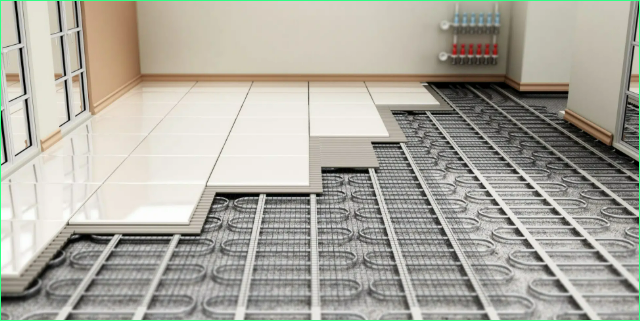
Underfloor heating with water. The most common. It uses a network of underground pipes through which water circulates.
Electric underfloor heating. Under the floor are cables through which electricity circulates to distribute heat.
The different water heating systems can be boilers, heat pumps and solar energy.
In any case, it is convenient to keep the system always on when it is cold to reach the temperature, but this does not mean that it will consume more because the room thermostat will regulate the start and stop of the system when the desired temperature is reached.
Energy consumption and efficiency of underfloor heating
Consumption does not depend on the radiant floor itself, which we have seen is a distribution element, like a radiator, but on the temperature generation system (water or light).
One of the most important points of underfloor heating is that it works with hot water at a low temperature (35°C). Traditional radiators work with high temperature water (70°C).
For example, gas condensing boilers can be used with radiators and underfloor heating. And they get better energy efficiency with underfloor heating, because the boiler’s performance improves when it is used at low temperatures. This takes advantage of the condensation system.
In this way the initial investment required by underfloor heating (slightly higher than that of radiators, if design elements are not chosen) is advantageous in the short term.
¡Síguenos en Facebook para recibir nuevas publicaciones!
Seguir en FacebookLatest Posts Published

10 ways to save when you want to design a garden with a swimming pool

How to grow rose bushes at home

Sunflowers: care, how to plant them and when to water them

3 types of grills suitable for your garden or terrace

How to build a toy box at home

Ideas for furnishing your terrace with wicker furniture

10 Rustic Terraces You’ll Love

How to create beautiful and very simple floral compositions

How to cure brown leaves that appear on avocados?