
Ornamental plants are increasingly popular. Learn how to enliven your home with the easiest and most attractive indoor climbing plants and how to reveal the plant lover inside you.
Plants are an important decorative feature in every home. It is not surprising that Millennials keep the sales of nurseries and incubators at all-time highs because plants today are valued more than ever, not just for their natural charm but also for their ability to blend seamlessly into any setting and purify the air.
If you have already successfully ventured into the realm of plants and pots, you will understand that the next move is to begin a decorative project where they are a key part of your area, and there is no better option for this than with a climbing plant.
 20 very realistic artificial plants for your home
Discover which are the best indoor climbing plants to beautify your home along with their essential care.
1. Pothos
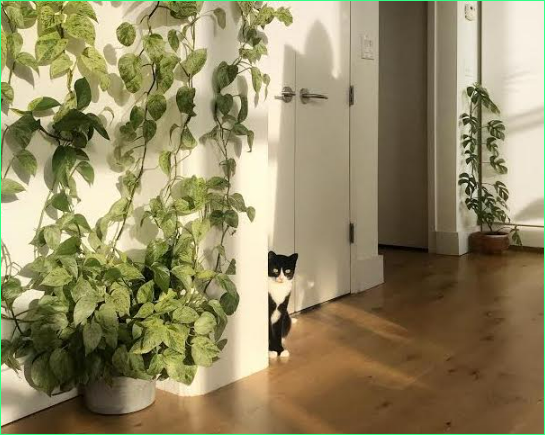
Although it can be confused with other similar species, the quality that makes this climbing plant unique is the variety of shades that its leaves emit, especially yellow or a lighter shade of green than the rest of the plant.
Pothos is a very noble plant and resistant to everything except direct sunlight. Any shaded space inside the house will be enough for it to grow quickly (even if you are not an expert): a few waterings a week are enough, or you can do it when the leaves and branches appear lowered. It is ideal to be the first climbing plant you grow indoors.
2. The ivy
Most varieties of ivy are easy to grow at home, but the small-leaved one is the most sought after for giving that touch of green to every corner of your home. It’s one of the most malleable plants you can have: you need to guide its larger branches according to your decorative interests, such as wrapping them between nets or columns or letting them cover a corner between two walls.
9 alternatives that you can use instead of white to furnish your homeIf you want to maintain green tones, it is better to receive natural light. Otherwise, the ivy will turn a darker green. Don’t worry about humidity, in fact this plant specializes in reducing it on walls.
3. Chain of hearts
Chain of hearts is a favorite climbing plant for indoors with limited space. These are small heart-shaped leaves, dark green (sometimes pale) in color with reddish details on the branches and on the underside of the leaves.
This plant is usually grown in hanging pots, both for its ability to follow the path by adhering to the base, and for the beauty of its natural fall with authentic shoots that form its branches. To keep it healthy it is necessary to moderate the water because they are more delicate than the previous ones, while they must receive at least a few hours of sun a day.
4. Plant ants
Despite their apparent sophistication, the almost round and intense green leaves of Dischidia nummularia require only one fundamental precaution: keep them near a window or door where they receive as much indirect light as possible.
Do you often receive guests? Here are the essential things in the houseThe leaves of the ant plant generally grow in pairs and resemble small coins or buttons that give a feeling of volume and leaves. An ideal climbing plant for bathrooms or rooms where it can grow sideways and, if hung, downwards in a controlled manner.
5. Monstera adansonii
Along with succulents, different varieties of monstera are a trend in interior design. Their personality and the characteristic holes in the leaves once mature make them one of the most sought-after plants for decorating the house and walls.
Unlike most plants in this family, Monstera adansonii has small leaves and a thinner stem that works great when placed in hanging pots to liven up any room. Slower and more careful growing than the more common climbers, it is essential to find a well-lit place where it does not receive direct sunlight. Monstera is more demanding when it comes to watering, which should be little but constant, on average every two days to make it grow in perfect conditions.
6. Ficus catarator
This plant has the ability to cover any space such as a pot, trunk or any rail in a short time, which is why it is used on a large scale to cover large spaces. Although outside it is regularly used as a new ornament thanks to its vertical growth, inside it is perfect to accompany a boho style enriched with natural motifs.
Ficus pumila is an oriental species that requires good lighting without receiving direct sunlight. Its small leaves multiply quickly and adhere to the plant’s immediate environment, so you’ll need to guide its growth from the moment you get home. As for watering, the general recommendation is to always keep it moist, but without flooding, because it tends to accumulate water and rot the roots.
¡Síguenos en Facebook para recibir nuevas publicaciones!
Seguir en FacebookLatest Posts Published

10 ways to save when you want to design a garden with a swimming pool

How to grow rose bushes at home

Sunflowers: care, how to plant them and when to water them

3 types of grills suitable for your garden or terrace

How to build a toy box at home

Ideas for furnishing your terrace with wicker furniture

10 Rustic Terraces You’ll Love

How to create beautiful and very simple floral compositions

How to cure brown leaves that appear on avocados?