
The African violet is a perfect plant for indoor areas, known for its lovely blooms and small size. Among blooming plants that make great long-term houseplants, no group is as significant as the Gesneriaceae. Most of its types are relatively small, but they all have lovely leaves and colorful flowers. Among these, African violets (Saintpaulias) and Gloxinia take the lead, followed by Achimenes and Collumneas. The latter, like three other key members of the family, Aeschynanthus, Episcea, and Hypocyrta, are natural climbers.
All Gesneriaceae require warmth, shade, and humidity for growth. The key is to find a nice balance. The darkness of a poorly lit room with few windows isn’t suitable, as plants need some light to thrive. Meanwhile, avoid direct sunlight. However, this method can also work for certain types, especially African violets, which surprisingly manage to handle sunspots without damage, provided the flowers and leaves are properly watered. These blooms and foliage can quickly wilt in the sun if they remain on wet soil.
African violet
Without a doubt, the favorite plant of the Gesneriaceae family – and perhaps of all houseplants – is the African violet (Saintpaulia ionantha). The main reason for this popularity is undoubtedly its ability to flower freely throughout the year – although summer and autumn are the best seasons – together with its compact appearance and brilliant colour. It was discovered in the mountains of East Africa in 1892, although its potential as a houseplant was not realized until the 1920s.
Apparently there are countless varieties of African violets, not to mention the others that will be added over time. Some last a long time, while others disappear quickly. Blue in its many shades is the basic color of this flower, but there are also white, pink, red and two-tone ones, with simple and double shapes. The list of names is overwhelming and a look at a specialist’s catalog reveals that finding new names for new introductions must be quite a serious problem.
Types of bathroom tilesWhile the flowers are, of course, the main attraction, the leaves are beautiful too. Heart-shaped, slightly fleshy and dark green in the upper part, with a velvety consistency, in some varieties the lower part is dark brown.
The fact that there are so many commercial and private growers willing to take on the breeding of these wonderful plants is a major plus for anyone growing one or two of this family on their windowsill. Individual flowers and flower clusters have improved greatly at the expense of recognition in recent years, but at the same time there has been a notable step forward with the development of a more resistant Saintpaulia strain.
Among the care of the African violet, one might comment that it likes pleasant warm conditions with temperatures no lower than 19 °C, because the permanently low temperatures give the plant a shriveled, tiny and lifeless appearance. Adequate light is also key, and plants will do much better, both in terms of appearance and general growth, if they receive artificial light at night; however, you must be careful not to bring them too close to strong lights, because both the foliage and the flowers would risk withering.
Giving advice to the beginner on how to water any plant presents many difficulties, because there are no definitive rules that can be established as a guide.
Renovate your bathroom and kitchen with tile paintHowever, if it can be said that saturation of the roots is the most serious failure, then it is necessary to try to water the dry parts. This, of course, is what happens with Saintpaulia, always without forgetting that the plants must be left to dry a little between applications. the application. Never use cold water and avoid getting it on the leaves or flowers, because they wilt very easily, especially if the plants are exposed to direct sun when they are still wet.
You only need to transplant every two years, and the new container should be only slightly larger than the old one. A peaty soil mix, reversing the amounts of peat and red clay, is essential to achieve a much lighter composition. Otherwise you can use a commercial peat mix or a special mix for Saintpaulia. Do not press down when planting.
Don’t repot too often: in a new mix, plants tend to grow much more vigorously than is good for them, and while actively growing this way, they tend to produce very few flowers. When the pot is well rooted, almost all plants will flower profusely.
The more reluctant ones can be stimulated to flower by keeping the roots drier than normal, or by fertilizing them with a fertilizer containing a high percentage of phosphates; nitrogen-rich fertilizers tend to encourage more leaf development at the expense of flowers.
Interior design fashion trends in 2024 to tryAfrican violets are not difficult to germinate from seeds, requiring a germination temperature of 18-21°C. Favorite plants can be propagated by division, but the simplest method is cuttings. They take root very easily in a mixture of peat and sand at around 20°C, or even with the ends of the stems simply immersed in water.
To obtain good African violets, the important thing is to guarantee them light, heat and humidity in reasonable measures, considering the situation inside them, because they positively detest any condition that does not meet their needs.
The African violet is a wonderful plant to grow indoors due to its beauty and ease of care.
Gloxinia
Of the Gesneriaceae family, second place, after the African violet, is occupied by the gloxinia, whose botanical name is Sinningia speciosa. With its long, velvety dark green leaves and large bell-shaped flowers, it is overall a very bright plant. It is also one of the easiest summer flowers to care for and one of the most beautiful colors. Its flowers can be purple, violet, scarlet, crimson, pink or white, with many bicolor flowers.
These plants are easy to germinate from seeds, sown a little at spring temperatures and gradually transplanted into slightly larger pots, as they are full of roots. It is essential to use a light and peaty mixture.
Over time, tubers form which can be stored for this purpose for up to a year, leaving the plants to dry once they have lost their attractiveness. Store the tubers in a warm, dry place and plant them in spring by burying them half in moist peat in a sheltered place. Transplant them into a more compact mix when they have developed some new leaves. These plants can also be grown by adding leaf cuttings from healthy plants.
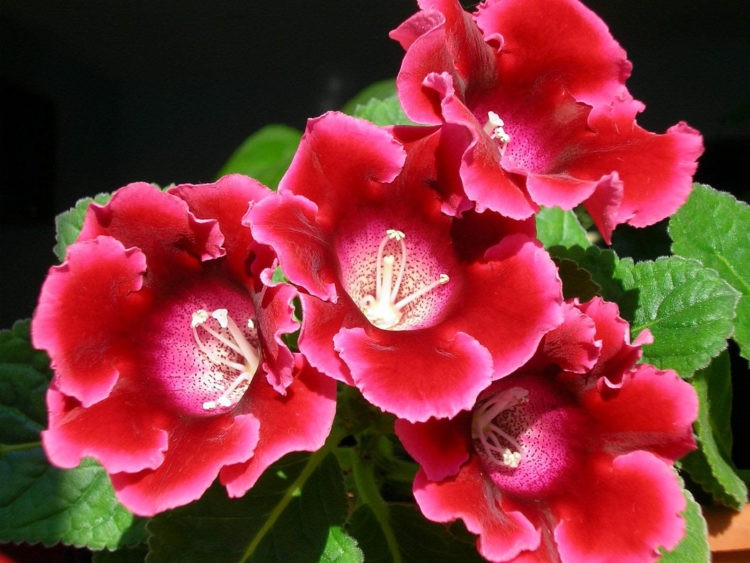
Gloxinia is a lasting herbaceous plant found in the Amazon regions of Brazil, featuring lovely soft leaves and trumpet-shaped blooms in various colors, ranging from white to purple.
Other similar plants
Among the other species in the Gesneriaceae family, the most recognized is the Achimenes, which has many types and options, take a look at the ones available. They reach heights of 25-30cm, with bright trumpet-shaped flowers in a wide variety of shades. The blooming season lasts from early summer to autumn.
These plants have rhizomes that grow in overlapping layers like a pine cone, and new plants can be created by breaking off these parts and planting them separately in damp peat in a warm spot. The local name of the Achimenes plant in some areas comes from the idea that if the rhizome is soaked in warm water before planting and growing – in late winter – it produces leaves much quicker. New plants can also be grown from seeds sown in early spring or from stem cuttings taken at the same time. As long as they remain moist, warm enough, and are fed, they can be some of the easiest to take care of.
With similar layered rhizomes, Kohleria does not require hot water treatment to speed up its growth. It should be treated like Achimenes, but it grows much more vigorously, reaching a height of a meter or more. Its flowers are also trumpet-shaped, and there are many varieties in colors like red, pink, and orange.
Smaller than Kohlerias but still tall, there are three other groups in the family: Gesneria (which gives it the name), Rechsteinera, and Smithiana. All have clusters of narrow tubular or bell-shaped brightly colored flowers – especially red – that bloom in autumn. They are tuberous – like gloxinia – but need an average temperature of 21 °C. Otherwise, they can be cared for in the same way as gloxinia. However, Gesnerias, despite starting to grow in early summer, only bloom in winter.
Lastly, another significant Gesneriaceae aside from those mentioned is Streptocarpus. Its fairly common leaves are nearly stemless, and its trumpet-shaped flowers grow on stems similar to those of the former. Many very delicate types exist, with white, pink, red, purple, or blue flowers, and they bloom for several months in warm, lightly shaded environments. They can be easily grown from both seeds and cuttings.
¡Síguenos en Facebook para recibir nuevas publicaciones!
Seguir en FacebookLatest Posts Published

10 ways to save when you want to design a garden with a swimming pool

How to grow rose bushes at home

Sunflowers: care, how to plant them and when to water them

3 types of grills suitable for your garden or terrace

How to build a toy box at home

Ideas for furnishing your terrace with wicker furniture

10 Rustic Terraces You’ll Love

How to create beautiful and very simple floral compositions

How to cure brown leaves that appear on avocados?