
When we think of travertine marble, Roman temples and amphitheatres, basilicas and classical buildings come to mind, but nothing could be further from the truth. Travertine is, in itself, a 21st century material, so it should be no surprise to see its distinctive structure as part of today’s architectural concepts. Still not convinced? Read on to learn more about the advantages and uses of a surface that has adapted to the new present.
What is travertine marble? Its origin and its role in architecture
Travertine marble, known in Italy as Tivoli stone, is a sedimentary limestone, which stands out for its porosity and shades of ocher and sand. It is a material that has been used for centuries: palaces, basilicas and temples have been decorated with this ornamental stone. From ancient Rome to the present day, travertine marble has been able to renew itself and adapt to new decoration styles.
Roman travertine
Travertine marble design is inevitably associated with the era of ancient Rome. It was one of the most used materials, the most important quarries were located in the Tivoli area, a few kilometers from Rome. A good example of the importance of travertine during the Empire is its presence in some of the most important buildings. We are talking, for example, about the Colosseum, the Theater of Marcellus or the Pantheon of Agrippa, monuments that stand out for their elegance and spectacular beauty.
Travertine in modern architecture
Today travertine marble has been reinvented and its use is no longer just a thing of the past. The material integrates fully into contemporary designs, becoming one of the favorite materials. The Jumex Museum, a new landmark of 21st century architectural design in Mexico, has a travertine marble facade. Or, going back in time, we find the pavilion that Mies Van der Rohe designed for the Universal Exposition of Barcelona in 1929. Up to four different types of this natural stone were used in this project.
15 colors that you can successfully combine with any shade of grayTypes of Travertine Marble
Travertine marble can feature a variety of colors and styles, making it a very attractive option for interior decoration. Furthermore, its current trend has led to the appearance of other materials capable of reproducing its unique qualities and characteristics. We can therefore distinguish between:
Classic travertine
Travertine has unique characteristics that distinguish it from conventional marble. When we talk about classic travertine we mean stone of natural origin, a porous variety of limestone.
There is a wide range of colours, from ocher and cream to red and yellow, making it a very attractive and versatile option, adaptable to any space. In the classic travertine marbles, delicate and soft tones predominate: the white color gives brightness, the more toasted colors stand out for their warmth and the grayer tones complete the most contemporary spaces.
Modern materials with a travertine look
The importance of travertine structure has a lot to do with the development of technology. Today various materials have managed to perfectly recreate its beauty, elegance and characteristics. And I do so to the extent that if we talk about travertine marble we can also refer to these new materials that have managed to capture its serene beauty.
Office in the living room or bedroom: where is it best to place it?Among all these new materials, the most complete and recommended option is porcelain stoneware, since its properties and characteristics surpass those of others. Great advances in production allow porcelain stoneware to achieve a luxurious, elegant and refined aesthetic.
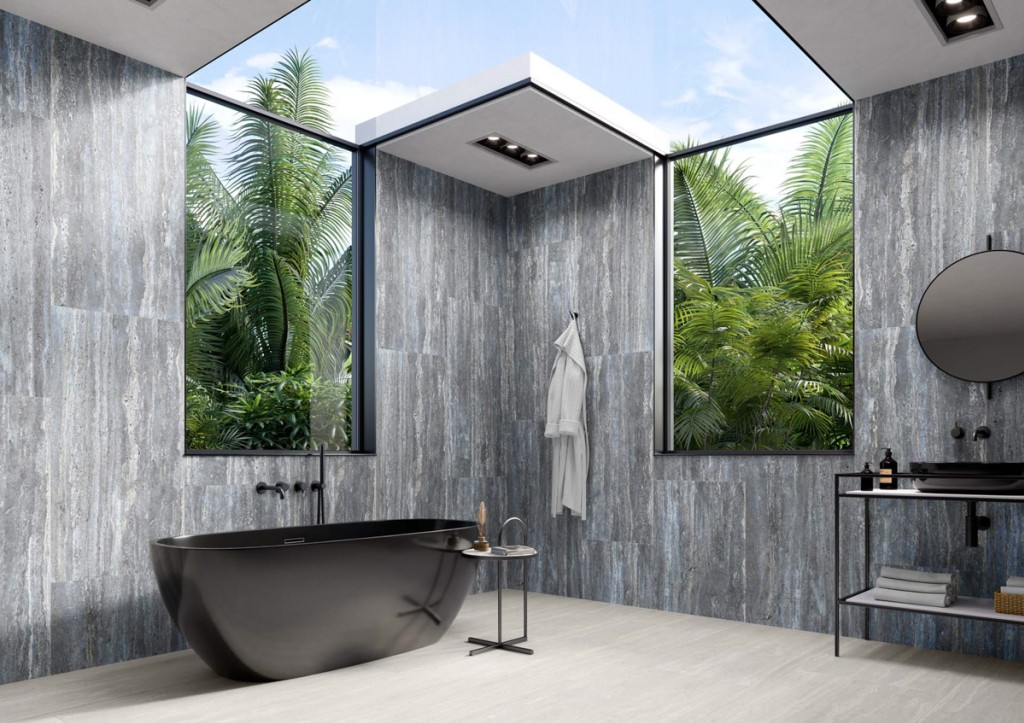
Travertine-look porcelain stoneware applications
Porcelain stoneware that imitates travertine marble is so realistic that it is difficult to distinguish it from real natural stone at first glance. The Apavisa Travertino collection, which belongs to the stone-effect porcelain stoneware family, has all the advantages offered by porcelain stoneware: resistance, durability and easy maintenance, among others.
Thanks to these technical characteristics, travertine-effect porcelain stoneware is extremely versatile and can be used both indoors and outdoors, both as flooring and as a covering. Its various options and classic appearance allow it to adapt to any space: kitchens, bathrooms and even dining room walls.
Internal and external floors
Travertine-effect porcelain stoneware floors stand out for their natural beauty and discreet design. This flooring is a very popular choice in interior decorations (living rooms, bedrooms, bathrooms…), as well as outdoors, where natural travertine was commonly used. It is also available with a non-slip finish, which guarantees greater safety on terraces, courtyards and wet areas.
 The 25 best shelves for storing books in the living room
A popular option when installing aesthetic travertine flooring is to opt for large format tile. Porcelain stoneware slabs reduce the number of joints, guaranteeing the visual continuity characteristic of the original material.
External facades
Historically, travertine marble has been used as a cladding for external facades due to its unparalleled elegance and beauty. A favorite choice for those looking for quality and luxury finishes, with a natural look.
Imitation travertine porcelain stoneware not only offers the aesthetics and personality of the original material, but also meets the necessary conditions to make it the best choice: resistance to humidity, shock and extreme temperatures, durability, easy maintenance and versatility. Furthermore it can be installed on all types of facade, both traditional and ventilated.
Colors of travertine marble
Travertino is the perfect collection because, in addition to all the advantages of porcelain stoneware mentioned above, it reproduces in detail some of the classic shades of travertine marble:
- White travertine marble: with Navona Matt you can create a large and welcoming space. The chromatic variety of cream marble gives elegance and serenity.
- Travertine marble in dark tones: the blue and brown tones stand out for their visual sense of depth and delicacy, creating a timeless space.
- Decorated stoneware: if you are looking for something different for your project, opt for decorative models that will undoubtedly give a unique personality to the room and remind you of the ornamental uses of travertine marble throughout history.
In short, the timelessness, elegance and beauty of this natural stone are reflected in the porcelain stoneware of the Apavisa Travertino collection, a decorative surface capable of resisting time, styles and trends.
¡Síguenos en Facebook para recibir nuevas publicaciones!
Seguir en FacebookLatest Posts Published

10 ways to save when you want to design a garden with a swimming pool

How to grow rose bushes at home

Sunflowers: care, how to plant them and when to water them

3 types of grills suitable for your garden or terrace

How to build a toy box at home

Ideas for furnishing your terrace with wicker furniture

10 Rustic Terraces You’ll Love

How to create beautiful and very simple floral compositions

How to cure brown leaves that appear on avocados?