The Japanese furniture style serves as the basis for numerous other styles, including minimalist and Nordic. Its neat, simple, elegant lines attract many individuals. Over time, it has evolved while keeping its core characteristics intact. This article will explore some contemporary Japanese style homes. We will begin with various exteriors and facades, as it is always exciting to appreciate the creativity of certain architects, and we will conclude with the interiors to witness how stunning Japanese houses appear inside today.
1. The modern Japanese-style house, with the charred cedar facade
Let’s start with the facades of modern Japanese houses. The house is made up of three layers of space of different nature. Seen from the street, the first layer is a black box, the second layer is hollow, with thin inclined steel pillars randomly piercing the space, and the third layer is a gabled black box floating on top.
2. Modern Japanese style house in Nagasaki
A wooden base was chosen for the house to blend in with the rural setting in which it is located. But, without a doubt, the black and white finishes allow you to see those hints of modernity in this Japanese house.
3. Modern, hexagonal house in Chiba, Japan
Overlooking the coastal waters of Chiba in Japan, a large hexagonal shell forms the central section of the SSK Villa, which features the creation of Takeshi Hirobe Architects.
Design ideas for a small terraceThe external walls of the villa also rise outwards, thus creating a shape that widens as one rises above the level of the base. Inside, the exposed beams responsible for structural integrity are kept bare and natural, creating a warm, contemporary and welcoming atmosphere.
4. Prefab Modern Japanese Residence
This is a mass-produced prefabricated house, often developed on a large scale and as such has the advantage of creating a complete townhouse. In many cases, because the appearance is coordinated with the owner’s designation, townhouses are created that do not necessarily match aesthetically.
To overcome this problem, 4 units are created together in Hozumidai which appear as a single designed building, bringing a strong message to the city. Price competitiveness was maintained thanks to the cost-effective production of the facade design.
5. Not a modern house in Tokyo
The site is located near central Tokyo. It is a small corner plot of 44 m2 bordered by two streets. In accordance with the legal conditions and in response to the client’s desire for a “garage roof”, the volume was cut from multiple directions. Using the words “Mineral” and “Reflection” as guiding concepts, Atelier Tekuto continued to use diminution as a positive tool for design.
Small ideas for furnishing your bathroom6. Modern, Japanese and white, very white
The site is located on a hill in a quiet residential neighborhood. The nearby houses are built close to the land on both sides, but behind is a lush forest, while in front you can admire a panorama of the city of Yokohama. Although the area is quite developed, you can hear the birds and enjoy the fresh air, making it an attractive place to live.
The rooms are arranged vertically and by combining the external spaces of the house, one can perceive the surrounding environment at all times. The gardens are accessible from every room and the openings are oriented in various directions so that the view of the sky and the forest can also be enjoyed through the other rooms.
7. The beautiful house with the vegetal facade
This building is a collective accommodation consisting of 11 units. The impersonality of the segmented residential complex is completely hidden in this architecture. Instead, it is built to be seen as a large house.
The architecture is covered with a wall in which holes are drilled. The shape of the holes resembles a trunk, leaves, roots and bulbs. It can also be seen as clouds floating above the trees.
What are the advantages of a pond and how to build one in your garden?8. Modern Japanese house in elegant blue color
Although the construction site is small, from the beginning they wanted to build a house that seemed big, as if the park was theirs too.
From the openness of the second-floor living space, with its windows and benches that make you feel like you’re sitting in the park and where you can keep an eye on your kids playing outside, to the split levels that allow you to easily communicate with family members and keep all places in the house connected, they’ve designed a space with a sense of security and tranquility.
9. Don’t crowd space in Japanese homes
Now we come to modern Japanese interiors. You won’t find a Japanese-style interior cluttered with small items and excess furniture. The ideal is to have nothing on the floor in traditional Japanese interiors, except a rice straw mat, called tatami. Other furniture that would be present includes a chest of drawers, a low wooden table with floor cushions to sit on, and rugs called futons that are hidden when not in use.
You will not encounter any distractions and, as a result, a feeling of weightless openness is created. A very good thing about traditional Japanese interiors is that it is a dust-free space that is easy to clean and keep clean.
10. Always add natural elements for a Japanese touch
Feinman, Inc.
The interior of traditional Japanese homes embraces nature and is something they have a lot of respect for. To bring nature into the home, there are a number of Japanese plants, such as bamboo and bonsai, to add Japanese culture to interiors. Likewise, any vegetation, such as orchids or palm trees, will also be suitable. In a Japanese interior you will not see colorful flower arrangements, etc., only natural, simple greenery.
11. No matter how modern, always add sliding doors
In Japan, space is limited and houses are expensive, so the traditional Japanese house will be small, especially compared to Western standards. Ancient Japanese interior designs have no doors or walls, but instead rely on fusuma (sliding doors) and shoji (moving screens) to divide rooms.
Glass windows do not matter, but shutters are used instead of windows, while screens are papered and illuminated, allowing adequate light to enter.
12. Don’t forget shoji in modern Japanese homes
A Japanese home design style does not use glass, but interesting ideas for incorporating light. A shoji plays an important role in a Japanese-style interior, as it is an authentic Japanese screen. It is a wooden or bamboo frame with translucent paper and slides instead of slamming like a traditional door. They are used for both external and internal walls.
13. This is a modern Japanese bathroom
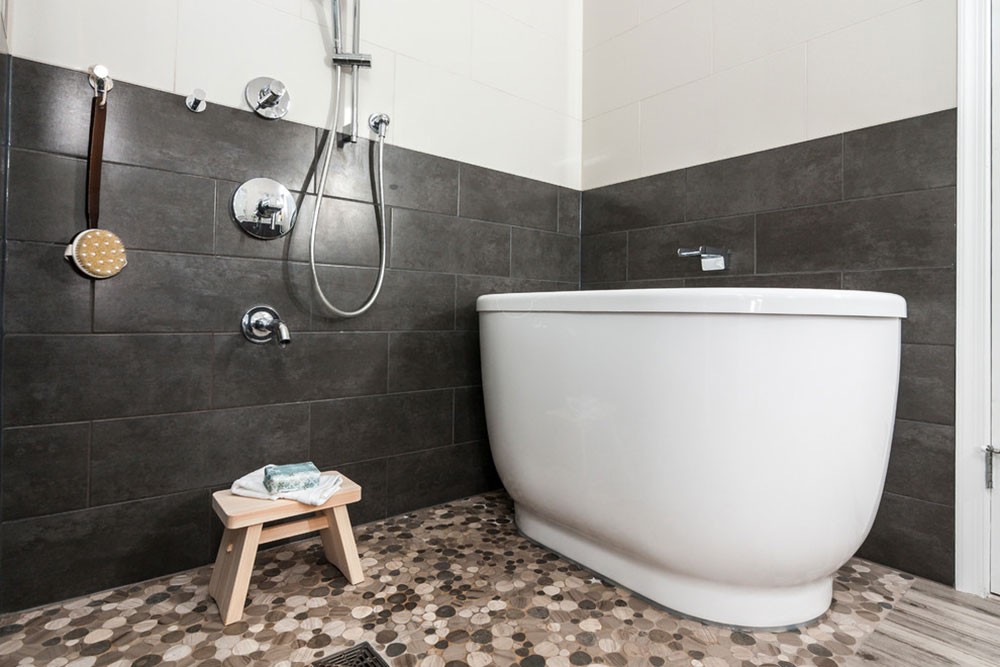
Japanese interior designers know the importance of a bathtub within a traditional Japanese home. An important and traditional Japanese decor is the incorporation of water into the home, which often only happens with a bathtub. These bathtubs are deep and quite small compared to some Western baths and have a small bench.
Japanese interior design always has elements of bamboo and wood. You will notice it in various places such as frames, grilles, doors and walls. When you want to add these common interior design concepts to a Western home, you can use natural woods such as Scots pine, hemlock, cypress, and maple. In the east and west, bamboo is the most used material.
Other ways you can imitate Japanese interior design include wooden partitions in your home and wooden floors.
15. Stunning entrance in modern Japanese style
When you refer to an entryway in Japanese style buildings, it’s a genkan. At the doorway this is where you take off your shoes and visitors will be welcomed. At the entrance of a typical Japanese home, stone tile floors are common.
The floors are usually made of gray stone tiles or wood, while the walls are typically replaced by panels covered in non-transparent paper. To align with the aspects of nature, natural shades such as green and brown are the main colors.
¡Síguenos en Facebook para recibir nuevas publicaciones!
Seguir en FacebookLatest Posts Published
10 ways to save when you want to design a garden with a swimming pool
How to grow rose bushes at home

Sunflowers: care, how to plant them and when to water them
3 types of grills suitable for your garden or terrace
How to build a toy box at home
Ideas for furnishing your terrace with wicker furniture
10 Rustic Terraces You’ll Love
How to create beautiful and very simple floral compositions
How to cure brown leaves that appear on avocados?