
The main aspect of decorating the area around a swimming pool is using strong plants that can thrive in the unique climate of a pool setting, usually placed in sunny spots, and that can create a look similar to a jungle and tropical areas, commonly found in South-East Asian nations.
In this piece, I have selected some swimming pool plants that can best adjust to this kind of setting and that can form a completely tropical and beautiful scene. Moreover, they are quite resilient and fit well in the typical conditions of this garden style.
In our minds, we picture various areas around a swimming pool, where plants definitely play a significant role. The lawn is one such area, but we view it more as an addition rather than a sole solution. It covers large regions of the ground for children’s and pets’ fun, yet leaves spaces that are begging to be filled with more plant species.
Depending on your preferences, you can opt for a dry area around your pool, selecting plants that don’t need much water, in shades of brown (grasses and grains), greyish-green (desert species and succulents), and pairing them with bigger bushes that need low care (like junipers and others).
8 ideas for decorating the living room in white and beige to inspire youAlternatively, you might want a more tropical setting, with larger plants and foliage, big leaves, and shady areas, where different types of Musa plants (banana trees), Alocasia, and more can be included.
Types of swimming pool surroundings
Based on the region we are in, we can mainly pick between a tropical theme, a Mediterranean pool theme, or a mixed one (a bit of everything). Let’s explore each of these.
Tropical pool theme
A very popular pool theme is the tropical one. This environment aims to mimic the tropical regions of South-East Asia (like Thailand, Vietnam, the Philippines, and especially Bali), featuring shaded spots and tall plants, but with many green branches and fewer harder stems.
In these settings, we choose plants that generally require warm weather nearly all year long, and they have a significant weakness against cold weather, so our garden should be situated in a warm location almost all the time.
 Ideas for furnishing the living room and bedroom with books
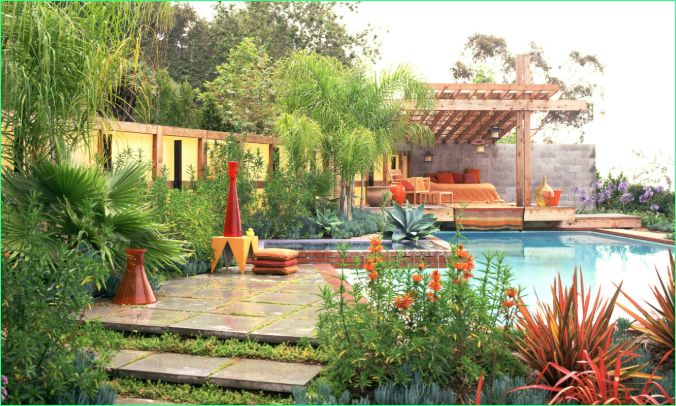
When selecting plants for this type of environment, broad-leaved evergreen options are noticeably favored (like Alocasia, ferns, climbing plants, banana trees, and others) along with tropical palms such as the feathered coconut, the conical palm, the Australian royal palm, and so on.
In addition to these plants, the use of wood and the creation of green walls is also highlighted, which in turn provide an extra shade area.
Mediterranean style swimming pools
The Mediterranean pool usually seeks white tones and plants in dark green and gray tones. It distinguishes itself by choosing species with limited resources, playing with low-growing plants, such as succulents and grasses, against a background of large trees such as conifers and palm species.
Tips for decorating and painting external wallsThis type of gardening usually coincides with the choice of xerophyte species, i.e. species accustomed to hostile, almost desert-like environments, with very limited water resources, such as cacti and succulents.
In the photo we can see the choice of plants for swimming pools in desert areas with an excellent combination of tall cacti (pear, saguaro, San Pedro cactus), with dwarf palms.
Types of Large Palm Trees for Your Pool Border:
- Canary palm or date palm
- Washingtonia robusta
- Livistona rotundifolia
List of swimming pool plants with good adaptation
Genus Musa (banana trees)
When we look for added value for our pool environment, with tropical tones and larger plants and voluminous leaves, the Musa genus can offer us some interesting species. This genus includes those known as banana trees, plants that require warm conditions year-round and good exposure to light.
Their growth is rapid and they can provide shade for the pool. If you like a warm environment, near the coast or the Mediterranean or the island area of Spain, you can afford to grow banana trees.
Growing conditions:
- Location and climate: shaded or semi-shaded environment, warm temperatures all year round and protected from strong winds.
- Soil type: deep soil rich in organic substance, good drainage and loose.
- Irrigation and fertilization: constant watering in the warmer months, fertilization at the end of winter to stimulate the sprouting of new leaves.
- Maintenance: constant throughout the year, guiding the development of the leaves and cutting those that have fallen, cracked or old.
Hibiscus (Hibiscus rosa-sinensis)
When looking for large bushes, with good hardiness and fantastic flowering, hibiscus can be an interesting option for pool plants. It adapts very well to warm environments and displays its vigorous flowering in spring and summer.
For growing the China rose the tropical environment is ideal, but if you don’t live there (as many do), mild winter conditions can be tolerated by the plant, with an environment full of light and away from cold winds.
Growing conditions:
- Location and climate: It resists the cold well, growing best in the most humid areas and with temperatures of 15-25 ºC. It is grown in full sun.
- Soil type: soil with good drainage and medium fertility. It is grown directly in the garden.
- Irrigation and fertilization: constant watering and application of fertilizer every 15 days in spring and summer.
- Maintenance: cutting at the end of the summer period, cutting old shoots, eliminating past flowers and guiding their growth.
Bird of paradise (Strelitzia reginae)
An outdoor plant that is gaining popularity year after year is the one known as the bird of paradise. Perfect as a pool plant in warm environments, vigorous and fast growing, with an attractive flowering resembling a bird’s head (hence its well-known name).
It can be grown both in pots indoors and in boxes with windows or directly in the ground outdoors, protected from strong winds and cold winters.
Growing conditions:
- Location and climate: sunny areas, cultivation in full sun or partial shade, sheltered from the wind and warm areas. Does not tolerate frost.
- Soil type: soil with good drainage and high fertility. It can be grown in pots or containers.
- Irrigation and fertilization: constant watering in spring and summer (2 or 3 times a week). Fertilized every 2 weeks at the end of winter.
- Maintenance: removal of old and excessively open leaves and separation of small ones.
Egyptian papyrus (Cyperus papyrus)
Seeking a jungle environment with plants that usually grow on river banks, the Egyptian papyrus is a plant fully adapted to humid conditions and with good resistance. It creates an exotic, tropical environment and can grow in all types of soil, especially those that retain moisture well (clay).
Growing conditions:
- Location and climate: shaded (or semi-shaded) areas, humid environment and high tolerance to different temperatures.
- Soil type: soil rich in organic substance, with good ability to conserve humidity.
- Watering and subscription: constant watering, which requires moisture in the soil. Reduced number of season ticket holders in spring and summer.
- Maintenance: cutting open and old leaves, cutting the stems a few centimeters from the ground.
Agave (Agave attenuata)
In the list of plants that tolerate any type of exposure and hot climate, the Agave genus offers us several varieties. Agave attenuata can be grown both in pots and directly in the ground.
Its fantastic grey-green leaves, leathery appearance and low maintenance, offer a great alternative for pool corners where we are looking for a more xerophytic landscape, with low water consumption species, gravel substrate and perennial species.
Growing conditions:
- Location and climate: mild and warm winters. Full sun exposure.
- Soil type: draining, sandy soils with excellent drainage.
- Irrigation and fertilization: very limited watering, once a week in summer and every 15-20 days in winter. Fertilized in spring and summer to stimulate sprouting, in small quantities.
- Maintenance: Low maintenance with cutting at the end of summer to clean the trunk.
Schefflera
Schefflera is well known as a houseplant, although it has slowly adapted very well to generally warm areas and coastal areas. It is used in swimming pool environments due to the greater humidity it receives and when larger species are sought (easily exceeding one meter in height), in more shaded areas.
It is an evergreen plant, so it pairs perfectly with tropical floral species and flowering shrubs.
Growing conditions:
- Location and climate: warm temperatures and optimal temperature range (13-25 ºC). Area protected from drafts and semi-shaded position, protected from frost.
- Soil type: rich in organic substance, deep and well ventilated.
- Irrigation and subscription: resistant to lack of water, moderate risks. Fertilize in spring and throughout the summer to stimulate budding.
- Maintenance: Low maintenance. Prune in late summer, removing crooked stems, brown leaves and growth guides.
Penniseto Rupelli
When looking for a herbaceous grass-like plant that covers a good amount of space in any pool area and provides a warm landscape typical of a Mediterranean garden, Pennisetum Rupelli is a great option.
It has an off-road development and very low maintenance requirements, with high resistance to environmental drought, high tolerance to water stress and very well-lit spaces.
We can grow this pool plant directly on the ground or in large pots and planters. The large budding it emits and the falling of its stems will make the container visually disappear.
Growing conditions:
- Location and climate: sunny areas and hot, semi-desert environments. Full sun exposure
- Soil type: medium type soil, good drainage and not necessarily fertile.
- Irrigation and fertilization: watering to a minimum, with weekly additions in small quantities. It does not require fertilization other than recovering the soil with compost or organic substance
- Maintenance: zero maintenance. Cut it once every few years if we want to reduce its foliage.
¡Síguenos en Facebook para recibir nuevas publicaciones!
Seguir en FacebookLatest Posts Published
10 ways to save when you want to design a garden with a swimming pool
How to grow rose bushes at home
Sunflowers: care, how to plant them and when to water them
3 types of grills suitable for your garden or terrace

How to build a toy box at home

Ideas for furnishing your terrace with wicker furniture

10 Rustic Terraces You’ll Love
How to create beautiful and very simple floral compositions

How to cure brown leaves that appear on avocados?