

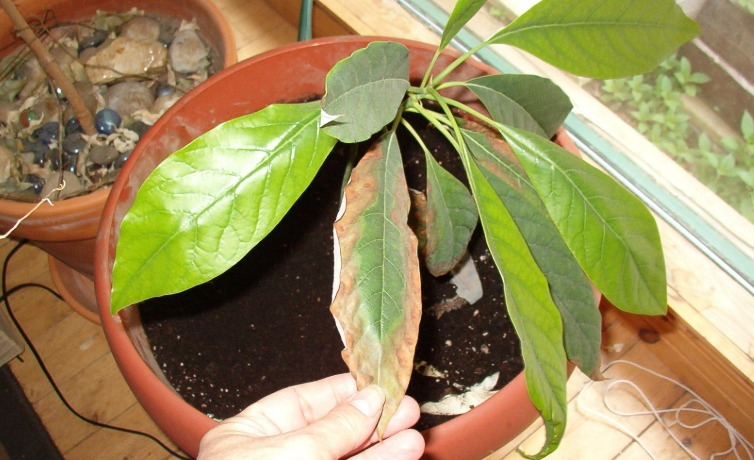
If you have noticed brown leaves on your avocado and are concerned about the health of your plant and the condition of your tree, it is important to know the causes to resolve and keep your tree healthy and there are no brown leaves on your avocado.
Environmental and climatological factors
There are several reasons why brown leaves may appear on avocados. Some causes have to do with the external environment and may be out of your control.
If you live in a region where the climate is extreme or you are very exposed to certain climate factors, these are usually the cause of brown leaves on avocados.
Some of these more severe weather conditions include dry winds, frost, hail, and strong sunlight.
In these cases it is important to be aware of the weather forecast and protect them so that our avocado does not have brown leaves.
If the risk is excessive heat, it is important to protect our plants from the sun, either by moving them to partial shade if the avocado is in a pot, or by placing protection in partial shade to occasionally cover the foliage. of the day when it is warmest
If the problem is the risk of frost, protecting the plant with a greenhouse or anti-frost fabric is an interesting option, although, if the plant is in a pot, you can also place it indoors.
An attractive option for potted avocados and to protect them from frost is to place the plant on a wall that receives afternoon sun.
What the wall will do is absorb heat during the day and protect the plant during the night, radiating heat and thus preventing frost from falling.
If the damage is greater and not only the leaves are burning, but also the stems and branches, then it will be necessary to cut the damaged area.
Before cutting it is advisable to wait for the tree to sprout again and only cut the branches that are actually dead.
The salinity of the environment can also be the cause for avocados to have brown leaves.
Salt is a problem, for example, in coastal regions, because this salinity is transported through the air and excessive exposure to salt damages the avocado.
In these cases it is advisable to periodically moisten the plant to wash the leaves of that salinity.
Excess salinity in the soil
The high salinity of irrigation water is also the cause of brown leaves on avocados.
In these cases the symptom appears on the tips of the leaves. They dry out, especially the leaves exposed to the sun.
As common sense may tell you, brown leaf tips appear more frequently on potted avocados than on those planted in the ground.
One way to avoid excess salts in the soil is to discard the soil in which the avocado is planted.
To wash the soil it is sufficient to water the plant well once a month. Abundant water will wash the soil, allowing salts to leave the root zone.
Lack of soil moisture, little water
If you have never placed a heavy layer of mulch around the avocado trunk or have recently removed the mulch you had, this absence could affect the amount of water the tree receives.
Or rather, facilitate the evaporation of irrigation water, limiting soil humidity.
Watering about 20 liters directly onto the soil about 50cm from the trunk will keep the plant adequately hydrated and prevent your avocado leaves from turning brown.
Damage under watering occurs when the leaf tips dry out.
If you have brown leaves on your avocado and you assume this is due to lack of moisture, then I recommend you start moisturizing the plant.
Watering the avocado with half the water, then waiting for the soil to absorb all the water and then adding the second half and maintaining a good layer of mulch can keep your tree happy, healthy and free of brown leaves.
Diseases and pests that cause brown leaves in avocados
Root rot
When infected by this particular fungus, brown leaves usually appear on avocados.
Avocado leaves will have reddish-brown spots. These spots will be larger along the vein of the leaf.
Usually, this disease appears after heavy rains and high humidity.
The best way to combat this fungus is to try to control it early.
When the tree is still planted, it should be grown in a bank or in a pot and it is preferable to use a sterile, disease-free substrate, because it risks introducing pathogenic agents into the plant that will become active at a certain point in the avocado’s life. .
Also, watering with stagnant or rotten water should be avoided.
It is important to maintain good air circulation and it will be extremely important to ensure sufficient space between the plants, so that no brown leaves appear on the avocado.
If your tree becomes infected, you will need to apply specific fungicides to treat the plant.
Root rot is also called avocado dieback, because the plant dies from the bottom up.
It is a very common disease in crops and can remain latent in the plant without generating symptoms until favorable conditions arise for it to awaken and kill the plant.
The ideal conditions for the development of the disease are floodplains with very poor drainage.
Clay soils are the worst for avocados because this type of soil with high moisture retention is where the disease thrives best.
The disease starts by killing the roots, then, not being able to absorb water and nutrients, the consequence is that brown leaves appear on your avocado, first the lower ones and then the upper ones until the plant dies.
If your soil is clayey and stays flooded or very wet for a long time, it is very likely that your avocado will have brown leaves due to this disease.
Once established, the disease is difficult to eradicate. The application of Trichoderma in the soil or the application of specific fungicides is recommended.
However, we will not eradicate this disease unless we improve soil drainage and add organic matter and agricultural plaster to lighten clay soil.
The most effective solution will always be prevention by planting on light soil with good drainage. If this possibility is not available, make mounds of earth and plant on top of these mounds.
If possible, it is ideal to select specific disease resistant varieties for avocado grafting, preferring resistant grafted legs.
Avocado mites
Mites can cause brown leaves on avocados.
The attack begins with small brown spots on the underside of the leaves and on the fruit itself.
These pests begin to appear in early spring and can continue to be a problem into the fall.
It’s a good idea to check the undersides of the leaves every week or so, as it’s always easier to get this problem under control early.
Depending on where you live, the problem can be solved naturally, without you having to do anything.
There are several insects that feed on these avocado mites. These are three beneficial insects that feed on these mites.
Beneficial insects that control avocado mites include a variety of black thrips, thrips, and some varieties of staphinid beetles.
If you see any of these insects, you probably don’t need to apply any type of acaricide; give them a week to see if nature takes care of the problem for you.
If these insects do not exist naturally in your area, you will have to solve the problem yourself.
Your options are commercial organic acaricides or applications of organic horticultural oils. These products must be applied according to the manufacturer’s instructions
You can try spraying water on the undersides of the leaves to prevent mites from attaching to them.
Choosing the latter option means that you have to put in a lot more effort and make sure that you are persistent in the treatment, so that the brown leaves on the avocado disappear.
Pata de alge, Cephaleuros virescens
Algal spot is caused by algae that settles on the leaves of the plant, and although it forms spots, it is unlikely to produce brown leaves on your avocado.
Although it is not aesthetically pleasing to have these spots, they do not affect the productivity of the plant.
To control it you need to apply fungicides.
How to Prevent Brown Leaves on Avocados
Keep the tree watered and make sure you have a protective layer of mulch to keep it well hydrated. The mulch will also reduce the effect of salt water on the tree.
Under the mulch, apply agricultural plaster to improve clay soil, up to 10 kg for a medium-sized avocado. This provides the tree with much-needed calcium and reduces the chances of root rot.
Avoid flooding the avocado soil. It is important to plant your tree in areas with good drainage, if this is not possible plant it in mounds.
You will also want to check the alkalinity and salinity of the water source – highly alkaline water will cause brown leaves on avocados.
Apply good amounts of organic matter in the spring and summer, your avocado plant will appreciate it with green leaves and will grow much healthier.
¡Síguenos en Facebook para recibir nuevas publicaciones!
Seguir en FacebookLatest Posts Published

10 ways to save when you want to design a garden with a swimming pool

How to grow rose bushes at home

Sunflowers: care, how to plant them and when to water them

3 types of grills suitable for your garden or terrace

How to build a toy box at home

Ideas for furnishing your terrace with wicker furniture

10 Rustic Terraces You’ll Love

How to create beautiful and very simple floral compositions

How to cure brown leaves that appear on avocados?