
What use will you give? Do you want it to be functional or rather decorative? Where do you want to install it? The size of the space and the use that will be given to it must be taken into account. For example, if you will walk on it barefoot or children will play, softer grass will be needed, because its use will perform decorative functions or you will always step on it barefoot. There are two types of artificial grass:
- Functional, which has a more artificial appearance. It is ideal for patios, decks or balconies. It’s monochrome and it’s cheaper. The pile height reaches 9 mm and has a drainage capacity of 30 liters per minute – if the floor is equipped with drainage -.
- The decorative one, which resembles the natural one more and can be installed in gardens, natural lands or residential areas. The hair measures between 20 and 40 mm and drains approximately 60 liters per minute per square meter. Additionally, there are many more color options, more softness and greater density.
Furthermore, in order to choose the artificial lawn best suited to our needs, we must also take into account other important characteristics:
- Dots per square meter. The greater the number of meshes per square metre, the thicker and denser the grass will be. That is, you will see it more or less abundant and dense.
- The basic composition. It is also important to know what material the base of the grass is made of: polypropylene, polyurethane or latex. The base is in contact with the ground and, depending on whether it is thicker or thinner, it will add more or less weight to the grass. This results in benefits such as stability, firmness and increased insulation.
- Types of fibers. They are available in different materials, shapes and sizes. This results in a more natural look, a variety of shades or a set of curly and straight hair.
- drainage points. All manufacturers will indicate drainage, but if you turn the lawn you will see small holes at the base of it to allow water to drain easily, so the more you have, the greater the drainage power.
How to lay artificial grass
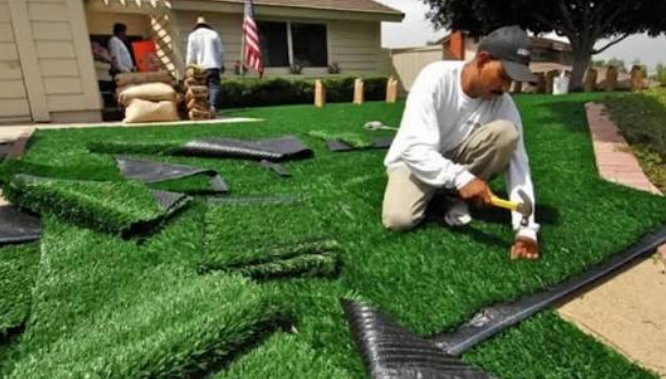
There are two ways to install artificial grass, depending on the size you purchase it in. It can be in rolls – the most common and durable option – or in boards, characterized by very simple and quick installation (although with a shorter service life). A fundamental thing to guarantee the durability of the artificial lawn is to take into account the support on which it is laid, which can be tiles or concrete and earth. Depending on the terrain, its installation is more or less simple. We explain it step by step.
Bohemian chic style decor: from bohemian to bohemian chicOne of the points to insist on if you intend to lay artificial grass is the measurement of both the space and the cut that we will need to cover the surface. The first thing to take is the measurements of the perimeter and the corners or particular areas, then measure the rest. For example, if you have a yard that is accessed through a porch, start measuring from there. If you choose to install the roll, make the least number of cuts to have the least number of joints. It is advisable to measure with a small margin and cut the excess part, this way you will avoid losing a few millimeters in a corner.
Install artificial grass on the ground
If you want your outdoor space to be green and beautiful all year round, artificial grass is the best solution. You will avoid many maintenance tasks.
- Step 1. To install artificial grass in the garden, the first thing to do is lay out a layer of gravel and then a layer of sand of at least 8 cm. In this way, perfect settlement and optimal drainage are achieved.
- Step 2. Smooth the ground. This step is fundamental, because the surface on which the grass will be installed must be flat and compact. To leave the soil perfectly prepared, use a roller or garden roller to compact and level the soil well.
- Step 3. Place the weed net. It is recommended to separate these layers with a geotextile mesh to prevent the sand from disappearing when draining the water. It will also help prevent weeds from emerging from the lawn. Cut it with the cutter into strips of the desired size, leaving about 10 cm extra at the ends.
- Step 4. Secure the mesh, both at the joints and around the perimeter of the installation.
- Step 5. When you have the base ready, unroll the strips of grass and place them on the layer of sand and gravel, avoiding wrinkles and folds.
- Step 6. Cut the strips with the utility knife behind the lawn. They must have the dimensions necessary to cover the entire perimeter. Cut where necessary, avoiding doing so along the line of the back threads.
- Step 7. Check if all parts fit properly. It is very important that, before finally joining the pieces, you check that the joints are imperceptible and that the grass fibers are oriented in the same direction, so that the different bands are not visible.
- Step 8. Allow the herb to rest between 24 and 48 hours to avoid the marks it can cause when it leaves the factory compressed into rolls.
- Step 8. Make the joints of the grass strips. It is advisable to take this step calmly. Making the joints is much simpler than it seems, you just need to be patient and careful when making them. To join two parts you can use a self-adhesive or normal joint tape, so that the layer of grass is more uniform.
- Step 9. It’s time to securely attach the grass to the ground. When the lawn is installed on the ground, it must be fixed with special staples to ensure its firmness and stability. Place them in the ground with a hammer.
- Step 10. Spread silicone sand over the entire surface. The grains will seep through the hair fibers, acting as a base and adding more weight to the herb itself.
- Step 11. Wait 24 hours to enjoy the installation.
How to put artificial grass on the terrace
If the floor of your terrace or balcony is made of concrete or tiles, the installation is much simpler, faster and cheaper, because you only need the joint tape and the glue to hold it in certain points and to ensure that the corners do not straighten. waking up It is important that the surface is flat and clean. It is also recommended that it has a slight slope towards the drain.
- Step 1. Clean the floor well and let it dry before starting the installation.
- Step 2. Introduce the grass rolls and cut them according to the needs of the space. Position the strips well to avoid creases and folds. Use the utility knife to cut a few strips of grass on each side and clean up the edges. Leave an excess of about 10 cm on the perimeter (you can cut once finished to perfectly adjust the edges).
- Step 3. Wait 24 to 48 hours after presenting the rolls for them to unfold well and lose any marks they may have when they left the factory.
- Step 4. You have two options for gluing the grass: with joint tapes and glue or use self-adhesive tape. Adhesive tape and glue: put on the first tape and apply the adhesive, which is usually two-component polyurethane, which requires homogeneous mixing of both products before application. You can also opt for a special artificial grass sealant that you can apply with a caulking gun. Apply the adhesive, without exceeding the quantity so that it does not overflow when joining the strips. Spread the product well with the notched trowel. Self-adhesive tape: it is the simplest system. You just need to remove the paper covering the sticker.
- Step 5. Place the grass edges on the strip. Press with your hands to make sure they are completely secured on both sides, taking care that the seams are not visible.
- Step 6. Wait 24 hours to enjoy the new flooring of your terrace or balcony.
Artificial grass on tiles, convenient and fast
The installation of this type of artificial lawn is so simple that all you need to do is match one tile to another. Of course it is best to install them on an even, hard and well-leveled floor.
 Caramel, cinnamon and olive green: the colors of the cold season
¡Síguenos en Facebook para recibir nuevas publicaciones!
Seguir en FacebookLatest Posts Published

10 ways to save when you want to design a garden with a swimming pool

How to grow rose bushes at home

Sunflowers: care, how to plant them and when to water them

3 types of grills suitable for your garden or terrace

How to build a toy box at home

Ideas for furnishing your terrace with wicker furniture

10 Rustic Terraces You’ll Love

How to create beautiful and very simple floral compositions

How to cure brown leaves that appear on avocados?